Type 21 vs. Type 9 Mechanical Seal: Which One Does Your Pump Need?
If you’ve ever ordered a replacement mechanical seal for a centrifugal pump and found yourself staring at a parts list that references a “Type 21” or “Type 9” seal, you’re not alone. These two seal designs are among the most common in industrial and commercial pump applications — and while they look similar at first glance, they are engineered for different conditions and are not interchangeable.
This guide explains exactly how each seal type works, what makes them different, and most importantly, how to choose the right one for your specific pump and application.
What Is a Mechanical Seal and Why Does It Matter?
Before diving into the differences between Type 21 and Type 9 seals, it helps to understand what a mechanical seal actually does. In any centrifugal pump, the rotating shaft that drives the impeller must pass through the stationary pump casing. Without a seal at this interface, process fluid would leak freely along the shaft — a maintenance problem at best, and a safety hazard at worst when handling chemicals, hot fluids, or hazardous materials.
A mechanical seal solves this problem by creating a dynamic, fluid-tight barrier between the rotating shaft and the stationary casing. It consists of two primary components: a rotating seal face that turns with the shaft, and a stationary seal face mounted in the pump casing. These two faces are held in precise contact under spring load, creating a sealing surface that prevents fluid from escaping while allowing the shaft to rotate freely.
The type of mechanical seal specified for a given pump depends on operating pressure, temperature, fluid chemistry, shaft size, and the physical space available in the seal chamber. Choosing the wrong seal type — or installing a seal with incompatible face materials — is one of the most common causes of premature seal failure and pump downtime.
Type 21 Mechanical Seal: The Single-Spring Standard
How It Works
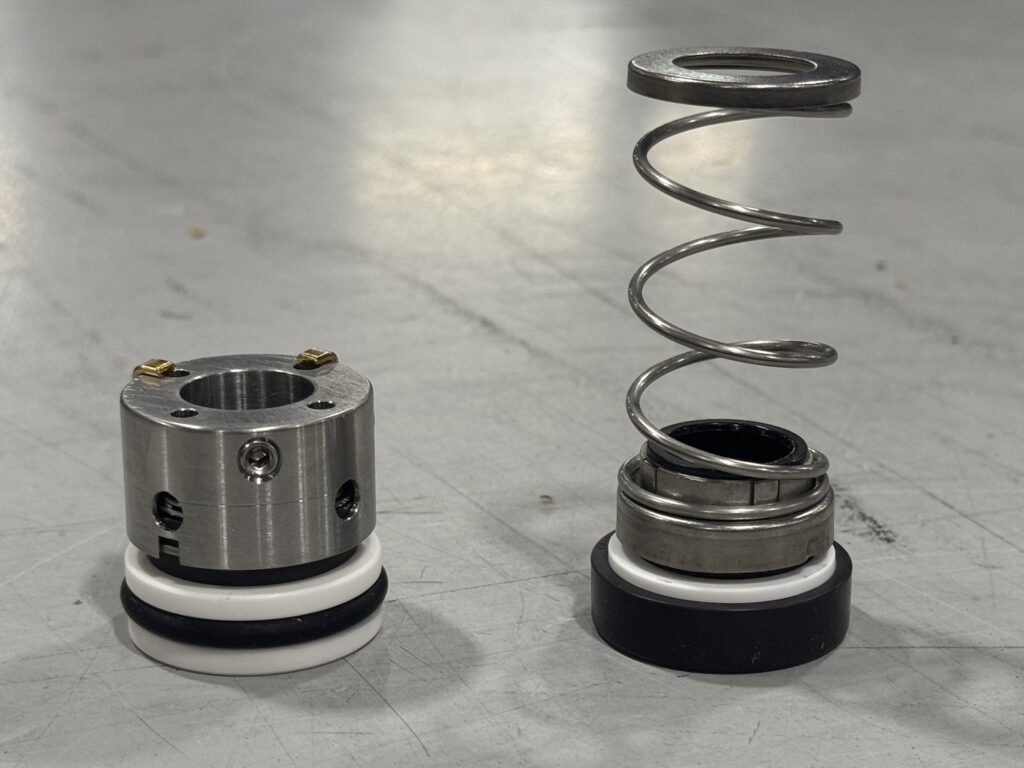
The Type 21 mechanical seal is a single-spring, internally mounted, unbalanced cartridge-style seal. Its defining characteristic is a single coil spring that loads the rotating seal face against the stationary seat. The spring surrounds the shaft and is driven by a drive collar or set screws that lock to the shaft, transmitting rotation to the seal face assembly.
The Type 9 is an “inside” seal, meaning the spring and seal components are located on the process fluid side of the seal faces. This design is simple, compact, and cost-effective — which is why the Type 9 has been an industry standard for decades in light to medium-duty pump applications.
Key Characteristics of the Type 21 Seal
- Single coil spring design — simple, reliable, and low-cost
- Internally mounted — spring is in contact with the process fluid
- Available in a wide range of shaft sizes from fractional to several inches
- Common face material combinations: carbon/ceramic, carbon/silicon carbide, carbon/stainless steel, graphite loaded silicon carbide (GLSiC)/GLSiC
- Elastomer options: Buna-N (nitrile), EPDM, Viton — selected based on fluid compatibility
- Typical operating range: ambient to moderate temperatures, lower pressure applications
- Standard fit for many OEM centrifugal pumps in light industrial and commercial service
Where the Type 21 Excels
The Type 21 mechanical seal is ideally suited for:
- Clean water, mild aqueous solutions, and non-aggressive process fluids
- Light chemical service where fluid is compatible with Buna-N or EPDM elastomers
- Lower pressure pump applications — typically below 50 PSI
- Ambient to moderate operating temperatures — generally below 180°F
- Standard centrifugal pump configurations in HVAC, water treatment, and general manufacturing
- Cost-sensitive applications where budget and simplicity take priority over extended seal life
The Type 21 is often described as the “bread and butter” mechanical seal of the pump industry — reliable, affordable, and perfectly adequate for a broad range of everyday applications.
Type 9 Mechanical Seal: Multi-Spring Performance
How It Works
The Type 9 mechanical seal is also a single-point, internally mounted, unbalanced seal — but it replaces the single coil spring with multiple small springs evenly distributed around the circumference of the seal. This multi-spring architecture is the key engineering difference between the Type 21 and the Type 9, and it has meaningful performance implications.
By distributing spring force evenly around the seal face rather than concentrating it through a single central spring, the Type 9 achieves more uniform face loading across the full sealing surface. This translates to better sealing performance, reduced face wear, and greater stability under conditions that would compromise a single-spring design.
Key Characteristics of the Type 9 Seal
- Multiple small springs — evenly distributed for uniform face loading
- More consistent sealing performance under varying speed and pressure conditions
- Better resistance to spring clogging in dirty or viscous fluid applications
- Less sensitive to shaft runout and minor misalignment than single-spring designs
- Same broad range of face material and elastomer options as Type 21
- Handles higher operating temperatures and pressures more reliably
- Preferred choice for more demanding process conditions and longer service intervals
Where the Type 9 Excels
The Type 9 mechanical seal is the preferred specification when:
- Operating temperatures exceed 180°F — multi-spring designs maintain consistent face load at elevated temperatures where single springs may relax
- Operating pressures are higher — more uniform face loading improves sealing integrity under elevated system pressure
- The fluid contains suspended solids or particulates that could clog or corrode a single large spring
- Longer mean time between maintenance intervals is a priority — more consistent face loading extends seal life
- Pump shaft runout or minor misalignment is a concern — multi-spring designs tolerate these conditions better
- Chemical processing applications where sealing reliability is critical to safety or product quality
- Higher-duty centrifugal pump applications in industrial manufacturing, chemical processing, and water treatment
When in doubt between a Type 9 and Type 21 for a borderline application, specifying the Type 9 is generally the conservative, lower-risk choice — the incremental cost difference is small compared to the cost of a premature seal failure.
Type 9 vs. Type 21: Side-by-Side Comparison
| Feature | Type 21 Seal | Type 9 Seal |
| Spring Design | Single coil spring | Multiple small springs |
| Face Loading | Centralized — single point | Uniform — distributed evenly |
| Temperature Range | Ambient to ~180°F | Ambient to higher temperatures |
| Pressure Rating | Lower pressure applications | Handles higher pressures better |
| Solids Tolerance | Spring can clog with debris | Multiple springs resist clogging |
| Misalignment Tolerance | Moderate | Better — distributes stress |
| Seal Life | Standard service life | Longer life in demanding service |
| Cost | Lower upfront cost | Slightly higher — better value long-term |
| Best Applications | Water, mild fluids, light duty | Chemicals, high temp, heavy duty |
| Maintenance Interval | Standard | Extended in demanding conditions |
Seal Face Material Selection: The Other Critical Choice
Regardless of whether you specify a Type 9 or Type 21, the seal face material pairing has an equally significant impact on seal performance and service life. The rotating and stationary faces must be compatible with each other and with the process fluid being handled.
Carbon / Ceramic
The most common and cost-effective combination for clean water and mild fluid service. Carbon provides self-lubricating properties; ceramic offers excellent hardness and wear resistance. Not recommended for abrasive fluids or highly aggressive chemicals.
Carbon / Silicon Carbide
A significant upgrade in wear resistance and chemical compatibility. Silicon carbide faces are exceptionally hard and perform well in abrasive, chemically aggressive, and high-temperature applications. The preferred choice for chemical processing service and anywhere ceramic faces have failed prematurely.
Silicon Carbide / Silicon Carbide
Both faces in the hardest available material — specified for the most severe abrasive or chemically aggressive service. Higher cost but dramatically extended seal life in the right applications.
Elastomer (O-ring) Selection
The secondary sealing elements — O-rings and drive bands — must be chemically compatible with the process fluid. Buna-N (nitrile) handles oils, fuels, and mild water service. EPDM is preferred for hot water, steam condensate, and many aqueous chemical solutions. Viton (FKM) provides superior resistance to aggressive solvents, acids, and high-temperature service.
Common Causes of Mechanical Seal Failure
Understanding why seals fail helps you both select the right replacement and address the root cause to prevent recurrence:
- Dry running — even briefly running a pump without fluid causes immediate seal face damage from heat and friction
- Incorrect installation — improper seal setting dimension or damaged O-rings during assembly
- Chemical incompatibility — wrong elastomer or face material for the process fluid
- Cavitation — vapor bubbles collapsing at the impeller transmit shock to the seal faces
- Excessive heat — seal chamber temperatures above the seal’s rating degrade elastomers and accelerate face wear
- Shaft misalignment or excessive runout — causes uneven face loading and accelerated wear, particularly in single-spring seals
- Wrong seal for the application — using a Type 21 in conditions that require a Type 9
How to Identify Which Seal Your Pump Uses
The simplest way to identify the correct replacement seal is to reference your pump’s original equipment manufacturer (OEM) documentation or parts list. Most pump manufacturers specify the seal type, size, and face material combination in their parts breakdown.
If documentation is unavailable, a qualified pump service technician can identify the seal type by inspection of the existing seal assembly. Key measurements include shaft diameter, seal chamber bore diameter, and installed height — all of which must match the replacement seal specification precisely.
Price Pump can cross-reference competitor pump models to identify the correct replacement seal specification — contact our parts team with your pump make, model, and serial number for fast assistance.
Not sure whether your application calls for a Type 9 or Type 21 seal? Price Pump’s engineering team is available to help you evaluate your operating conditions and specify the right seal and face material combination for maximum service life. Contact us for expert seal selection support.
Conclusion
The choice between a Type 9 and Type 21 mechanical seal comes down to your operating conditions. For clean water, mild fluids, and light-duty applications running at moderate temperatures and pressures, the Type 21 is a proven, cost-effective solution. For higher temperatures, elevated pressures, chemically aggressive fluids, or applications where seal longevity and reliability are paramount, the Type 9’s multi-spring design delivers superior performance and longer service intervals.
Getting the seal selection right the first time — including face materials and elastomers matched to your process fluid — is the single most effective step you can take to maximize pump uptime and reduce maintenance costs. Price Pump stocks a comprehensive range of Type 9 and Type 21 mechanical seals in multiple sizes and material combinations, available for fast shipment to keep your operation running.